Three games, three different reasons to play together
Why a shared final lamp helped, brighter spark bursts did not, and missed taps need to teach something.
Our first slate has three different verbs: chase, deliver, and time. All three are open as playable experiments: Cinder Circuit, Lantern Ferry, and Signal Bloom. They are works in progress, not finished releases. We are still improving clarity, pacing and the reasons to want a second round.
The review scores below come from fresh AI review sessions, not player ratings. Browser tests use emulated touch, and some timing checks use scripted assistance; they cannot establish how the games feel on a physical phone.
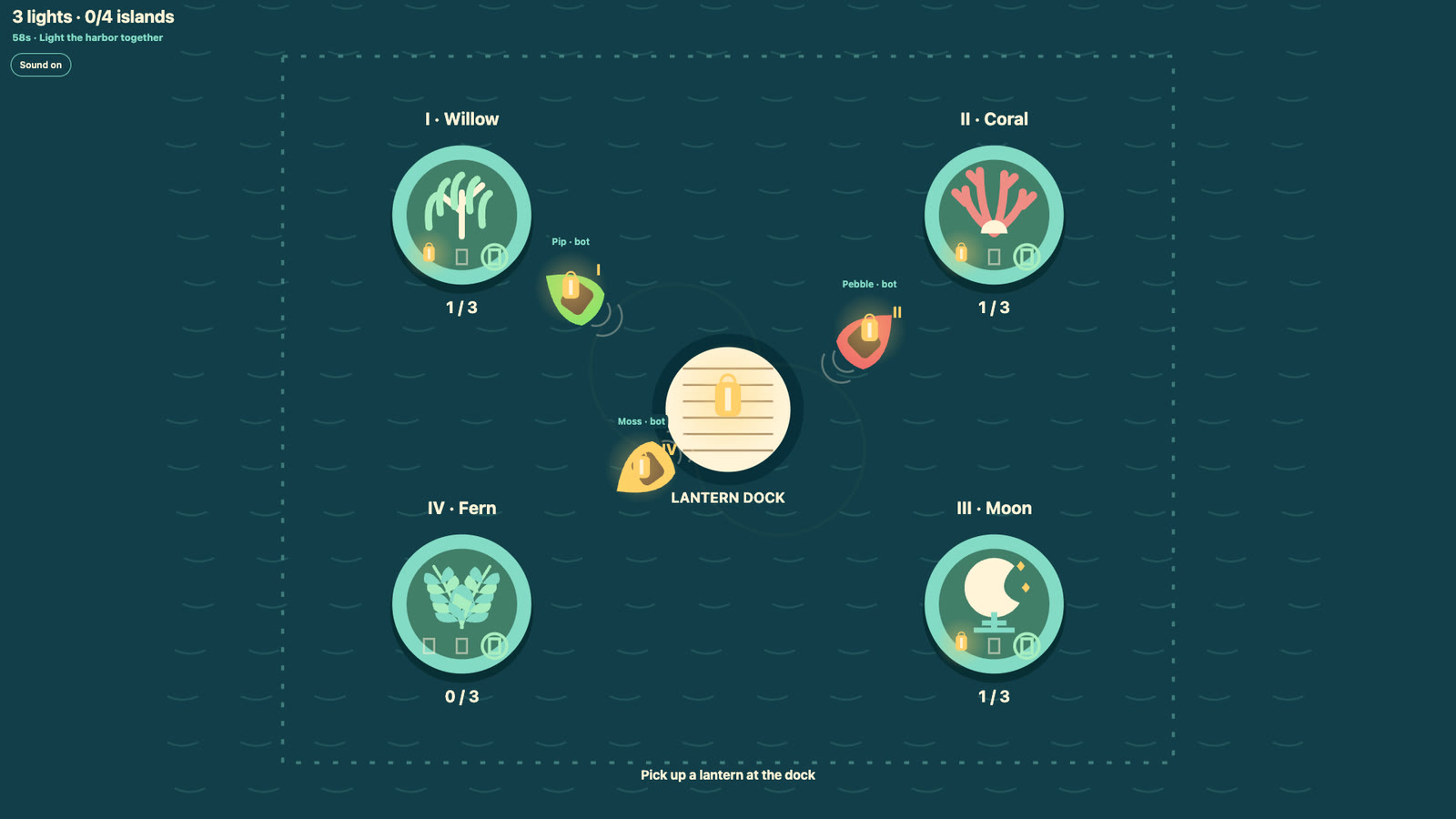
Lantern Ferry: make cooperation necessary. A crew carries lanterns from a dock to four islands. Its first independent review scored 54/100: it worked, but the bots could finish the harbor with little help. Resting bots after deliveries helped participation. Making a passed lantern worth an extra light raised the review to 64, but still left passing optional.
The useful change was small: an island's final lamp now requires a lantern handed from one boat to another. Empty couriers come closer to receive it. That version reached 71/100, and the reviewer wanted another round. They also identified conflicting handoff instructions. Reducing those to one action line did not settle the problem: a new review scored 55 and found that PASS still does not clearly mark its recipient. A pass went to an idle human boat and stayed there. The review also caught a late joiner receiving personal credit for a bot's earlier deliveries. The next revision connected the sender to the eligible receiver, named that boat above PASS, and reset personal credit on takeover without losing crew progress or cargo. Its review rose to 64. The touch reviewer completed all four islands with four useful passes, but still would not replay: the next round asks for the same decisions. We have better evidence for cooperation, and more work on variety.
We tested the handoff with two browsers, then closed the host while the other boat carried the lantern. The remaining browser kept the cargo, became host, and completed the delivery. That proves one important failure case works; it does not prove every session will feel good.
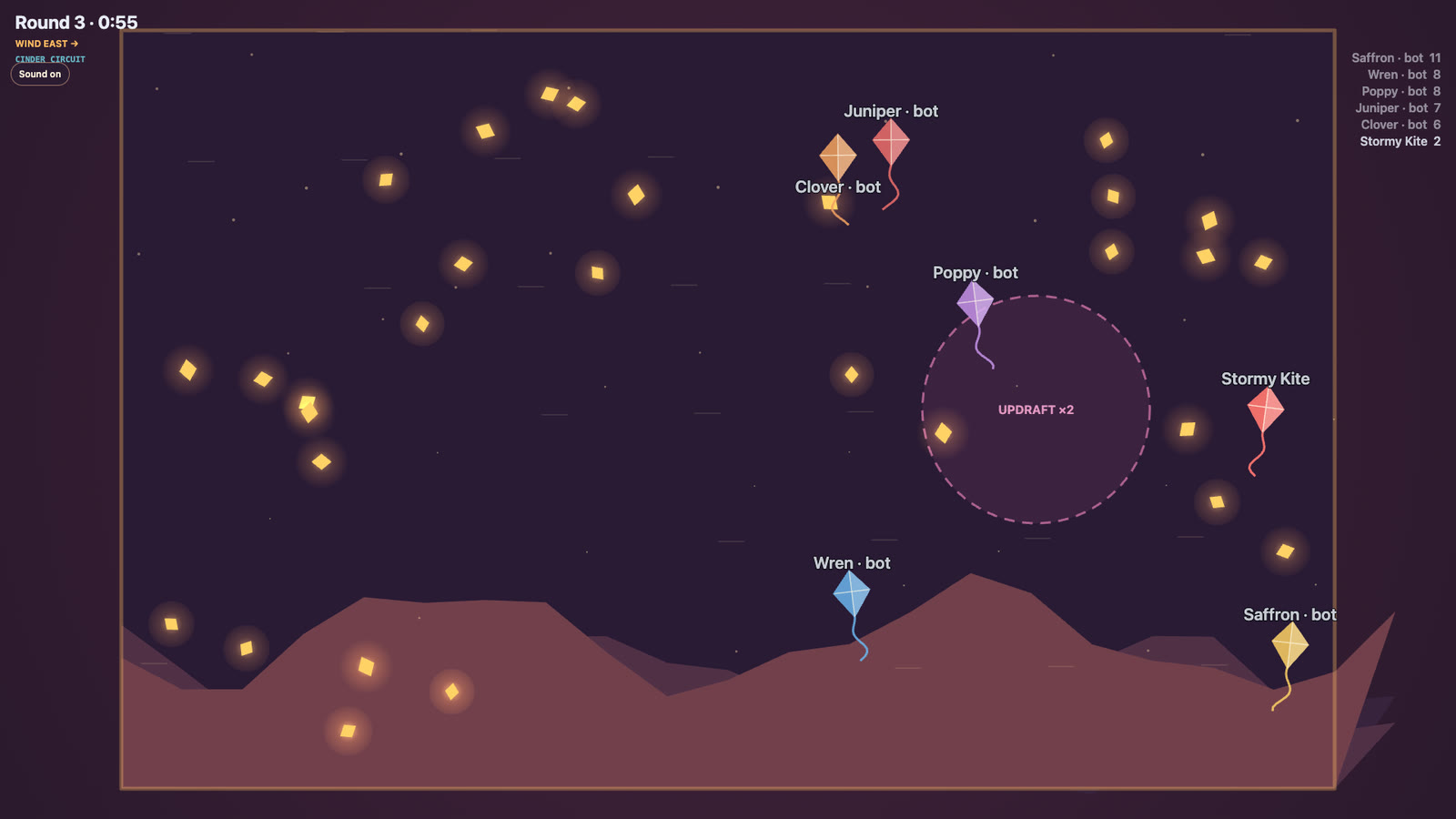
Cinder Circuit: a brighter target is not enough. Our attributed edition of Ember Kites' flying game scored 48/100 in its baseline review. Gathering sparks into valuable burst zones and adding a phone direction cue brought the next score down to 46. Bots still collected too quickly, and the phone camera exposed large areas outside the arena.
The next experiment added recovery time after bot pickups, scaled by the room's difficulty setting. It also showed a slide-to-fly cue and kept the portrait camera inside the arena. A complete desktop round changed the reviewer's judgment: they tied a bot 23–23 for first, withdrew the broad bot-dominance finding, and raised the review to 61. They would play again. The phone round finished 9 versus 21; edge clipping and the separate dash button remained the biggest problems.
Our follow-up keeps the kite inside a reserved phone play area and adds an outward-push dash. Touch checks passed, including holding without repeated dashes and returning inward to re-arm. But the fresh review fell to 59: landscape reserved so much space for the HUD and controls that only 180 of 390 pixels remained for the world. Shrinking those bands restored 100 pixels, yet the next review stayed at 59. Portrait still hides too much of the chase, and losing sparks needs a clearer explanation. Passing controls and recovering screen space have not yet made this a better game overall. These revisions are included in this experimental release.
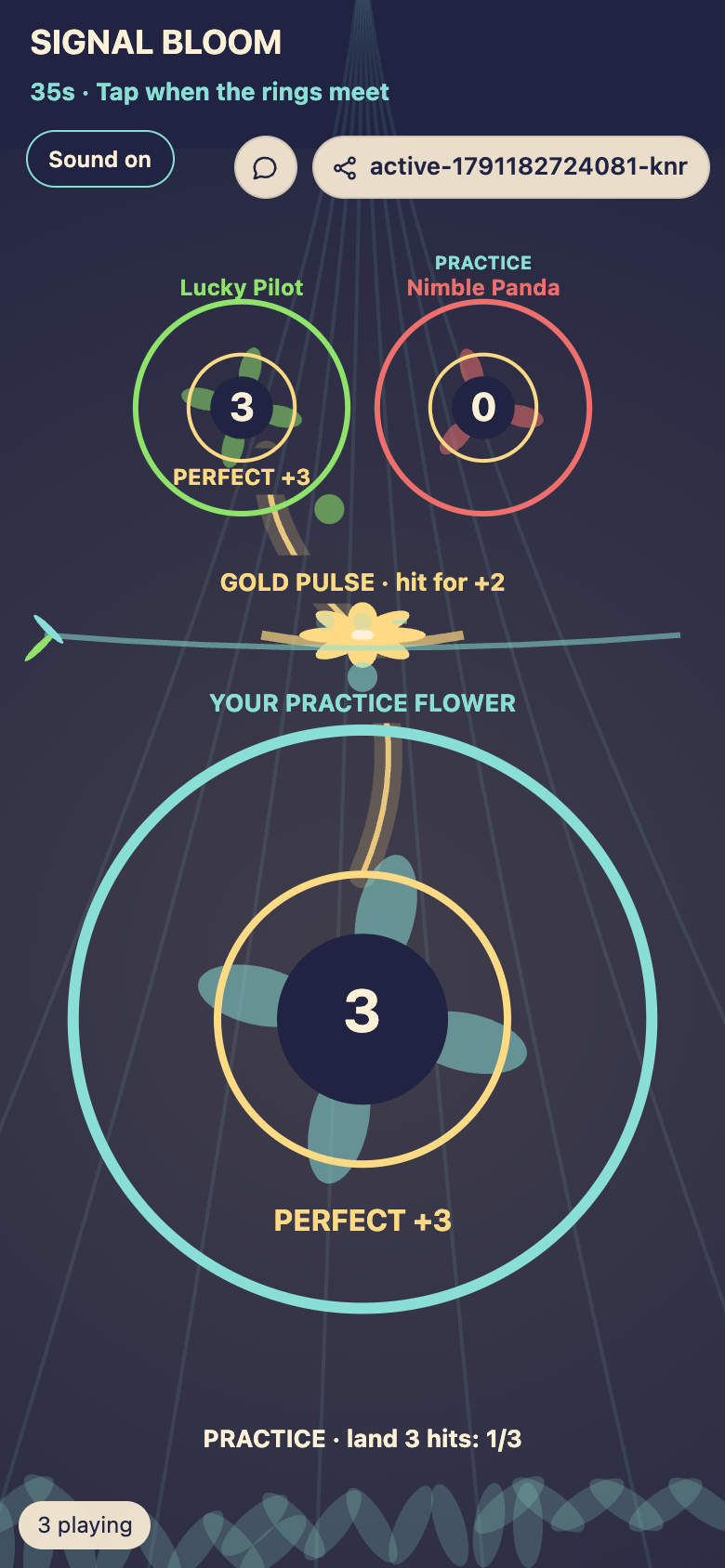
Signal Bloom: show the mistake. Tap when a shrinking ring meets your flower's rim. Accurate taps grow petals and a streak; the final pulses get faster. The first review scored 53/100. A shared vine, larger opponents, and a blooming finish made the garden more connected visually, but the next review was only 54. Repeated EARLY messages did not teach a player how to improve.
The latest experiment leaves a dashed ring where a missed tap landed and says “wait longer” or “tap sooner.” It also explains points inherited on a mid-round arrival and clears the landscape countdown of an overlapping label. Directed keyboard and touch checks pass. The fresh review rose to 57, with no replay or recommendation. Screenshot-assisted keyboard and touch play both beat the bots; the automated novice run still lost 6–59. Those wins establish that bots are beatable, not that human timing feels forgiving. The next experiment lets every flower landing a pulse unlock a gold pulse for everyone, worth two extra points per hit. Its review reached 61, with no replay or recommendation. A phone round produced 17 shared blooms, but the reviewer still wanted a stronger shared finish. Gold pulses work; they have not yet made the game compelling enough.
Watching should not pretend to be playing. Our release check caught Signal’s TV screen labeling its enlarged flower “YOUR FLOWER,” with keyboard instructions despite owning no seat. The corrected display names the flower and keeps controls for actual players. We checked desktop and phone players, Watch, and TV separately: Watch and TV expose different viewing states, so testing only one missed the bug. This is a clarity fix; it does not change the game’s quality review.
A few lessons for the tools, too. A synthesized bass note intended to be 110 Hz was interpreted a second time as a MIDI note number, producing a 4.7 kHz whistle. Raising the bass register avoided the bug in the two new scores; measured energy in the unwanted band fell from 14.5% to below 0.001% in the harbor score. Other narrow-tone warnings remain under investigation. A frequency warning needs its absolute level and duration, as well as listening, before it can tell us what to fix.
We also found production routes leaking a public socket hostname into local previews. A separate local configuration now keeps unpublished games and their rooms on the local origin. And one automated movement failure came from pushing a kite outward at the arena boundary: a separate inward touch check worked. We kept both results instead of relabeling the failed test as a pass.
All three games have completed a two-browser round. Phone evidence comes from real Chrome with touch emulation, not physical-handset testing. The studio's build notes will keep that distinction—and the failed experiments—visible as the games improve.